Your API gives you rates.
We give you revenue.
Stop converting currencies. Start converting customers.
Currencit gives you purchasing power parity, margin protection, and point-in-time precision - so you charge the right price in every market.
Fact: SaaS companies using PPP pricing see 22% higher global ARR
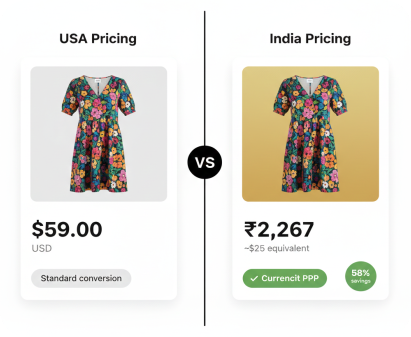
Same dress. Pricing that aligns to regional purchasing power.
More customers globally.
Financial Data For Your Apps
Accurate rates for fiat, crypto and commodities with realtime syncing and alerts.
Live Market Pulse
Built by Developers, Trusted by Global Finance.
Join the network fueling real-time decisions across 6 continents.
Serving Multiple Industries
Stop Pricing for One Country. Start Selling to the World.
A $29 subscription is a 'no-brainer' in San Francisco, but it’s a luxury barrier in Mumbai or São Paulo. If you aren't adjusting for local purchasing power, you are locking out 80% of your potential global market.
Our Smart Pricing (PPP) API automatically calculates the 'fair' local equivalent of your USD price. Convert the world’s emerging middle class into paying subscribers without manually tracking 100+ economies.
Stop Losing Your Margins to 'Hidden' Bank Fees.
You sell in EUR but buy inventory in USD. Between the mid-market gap and payment gateway fees (Stripe/PayPal), your 20% margin is actually 14%—and a sudden currency swing could wipe out the rest.
Our Margin Simulator builds automated 'risk buffers' into your retail rates. We calculate the spread needed to cover gateway fees and market volatility, ensuring every checkout is actually profitable.
Real-Time Edge for High-Frequency Liquidity.
In Fintech, 'stale' data is a liability. If your app is 5 minutes behind the market, your users lose money on transfers and your liquidity pools are exposed to toxic arbitrage.
Subscribe to sub-second Webhook triggers and live WebSockets. Our Redis-backed architecture pushes 0.05% market shifts to your system instantly, enabling automated hedging and user fomo-notifications.
Precision PIT History for Audit-Proof Reporting.
Daily averages are for amateurs. When a $2M contract is signed at 2:14 PM UTC, using a 'Daily Close' rate for the ledger is a compliance nightmare in volatile markets.
Our Point-in-Time (PIT) engine queries exchange rates down to the exact second. We provide a verifiable, immutable source of truth for high-stakes reconciliation and legal disputes.
Time Your Purchases, Optimize Global Payroll.
Steel from China costs 5% more tomorrow because you bought on the wrong day. Contractors in 50 countries need fair pay in local currency—calculated wrong, and they quit.
Use OHLC analytics to spot trends before they hit your supply chain. Combine with PPP to ensure equitable pay for remote teams that matches their local cost of living.
Tick-Level Precision for Algorithmic Alpha.
Backtesting on 'Daily Averages' is why strategies fail in production. To win in the markets, you need the same tick-level history and sub-second triggers that the big banks use.
Access 26+ years of tick-level history for backtesting and high-frequency Webhook triggers for execution. Our QuestDB infrastructure ensures your bot sees the market before the retail crowd.
Hedge Global Risk, Protect Your Local Bottom Line.
When you ship goods across borders, the 30 days between the invoice and payment is a gamble. One bad week for the Dollar, and your entire profit margin on a container is gone.
Analyze 30-day OHLC trends to time your invoices and use our Margin Simulator to bake currency risk into your quotes. We give exporters the 'Fair Value' intel needed to negotiate better B2B deals.
Why Purchasing Power Should Matter To You!
Netflix is cheaper in
The world's leading brands don't just offer products in local currencies; they adjust for Purchasing Power Parity (PPP).
By charging everyone the same rate, you are leaving money on the table in premium markets and locking out users in emerging ones.

The Netflix Strategy
The global standard in geographic price discrimination. Netflix optimizes Average Revenue Per User (ARPU) by indexing subscription costs against local Purchasing Power Parity (PPP), ensuring market penetration in high-growth, low-income regions.